



Labcorp Plasma Detect ID MRD for Breast Cancer (Stage I-III)
Labcorp Plasma Detect ID MRD for breast cancer (stage I-III) defines a personalized, tumor-informed MRD signature by analyzing whole exome sequencing (WES) of tumor DNA and matched germline DNA collected at the baseline timepoint. Based on this analysis, a patient’s tumor specific panel of 18–50 variants is developed to detect ctDNA in blood samples, both at the baseline and monitoring timepoints.

Unmet clinical need for molecular residual disease (MRD) testing in breast cancer1-3
High relapse rates despite curative therapy
The risk of distant recurrence remains significant, ranging from approximately 10% to 40%, depending on tumor subtype and nodal involvement, over a 5- to 20-year period
Limitations of standard surveillance tools
Standard imaging tools (mammography, MRI, CT scan) typically detect recurrence only after subclinical disease is present
Lack of sensitivity for microscopic disease:
After curative-intent surgery or chemoradiotherapy, subclinical disease cannot be reliably measured with existing surveillance modalities due to lack of sensitivity for early molecular relapse detection
Opportunity for earlier intervention
Studies demonstrate that presence of ctDNA can identify molecular recurrence months before radiographic progression, enabling timely intervention
Why choose Labcorp Plasma Detect ID MRD
for breast cancer (stage I-III)
-
Highly sensitive MRD test*: Detects ctDNA at levels as low as 0.005% (50 PPM)
-
Proven analytical precision*: Demonstrates >99.9% sensitivity and >99.9% specificity at the reported limit of detection
-
Early recurrence signal: Provides a median lead time of ~11.7 months before clinical or radiologic evidence of recurrence3

*Sensitivity and specificity data derived from an internal analytical validation study
Clinical evidence for Labcorp Plasma Detect ID MRD
in breast cancer (stage I-III)3
Clinical sensitivity of serial MRD
The assay demonstrated 77% sensitivity for identifying ctDNA in patients who experienced clinical relapse during surveillance.
Longitudinal ctDNA monitoring identifies patients at high risk of recurrence
Patients with detectable ctDNA had a 37‑fold higher risk of disease recurrence compared with patients who were ctDNA‑negative during surveillance.
Early molecular detection provides months of lead time over standard‑of‑care surveillance tools
ctDNA detection by the Labcorp Plasma Detect ID MRD test preceded clinical or radiological evidence of recurrence by a median of 11.7 months; notably, ctDNA was detected an average of 4.8 months before clinical identification of brain metastases.
Subtype‑specific patterns
Baseline (pre‑treatment) ctDNA detection was most frequent in triple‑negative breast cancer (TNBC), followed by hormone receptor–positive (HR+) and HER2‑positive tumors. During longitudinal monitoring, ctDNA‑positive results occurred most often in HR+ tumors, then TNBC, and least often in HER2+ disease.
Sample requirements for baseline and longitudinal timepoints
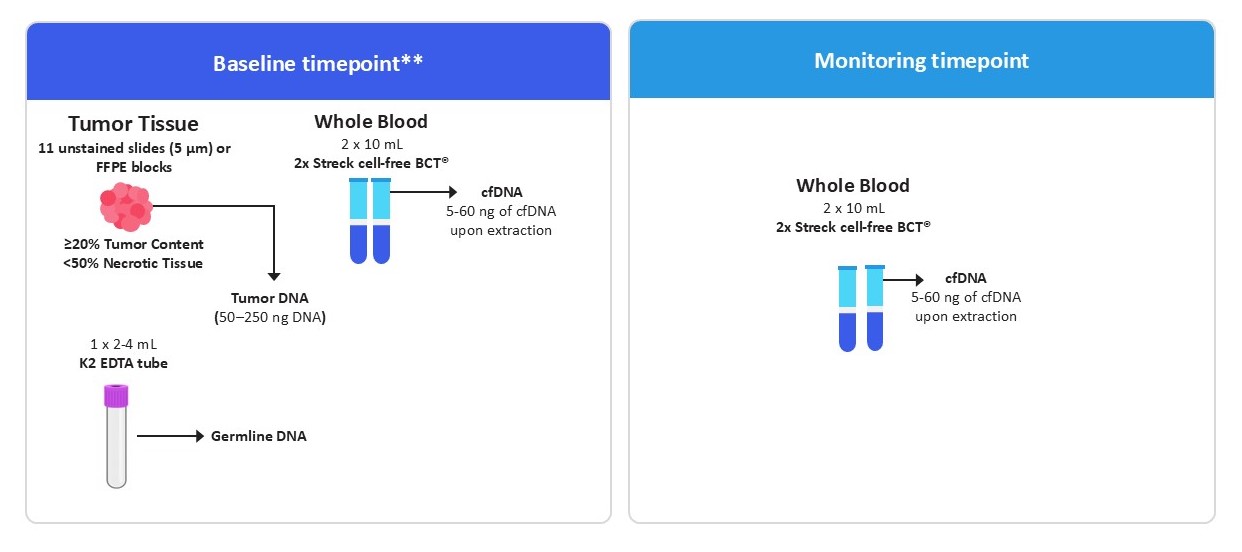
Baseline results are delivered in 35-42 days
Monitoring results are delivered in 7-14 days
**Both tissue and blood samples are required for the baseline analysis.
How to order
To begin testing, first order the Labcorp Plasma Detect ID specimen collection kit.
After the kit order is placed, the test may be ordered using a test requisition form, through the Labcorp Link portal, or via your EHR using your Labcorp clinical account number.
Your Labcorp Oncology representative will work with you to implement the ordering method that best fits your clinical workflow.
Clinical support
Our team of pathologists and oncologists is available to support you and your practice:
- Email: [email protected]
- Phone: 800‑366‑7230
- Fax: 919‑361‑7296
Why partner with Labcorp for your oncology testing needs
Streamline your workflow with MRD tests that can be ordered from a broad cancer diagnostic portfolio
Comprehensive
A full spectrum of oncology and clinical testing across the continuum of care: spanning screening, risk assessment, diagnostics, prognostics, monitoring, and surveillance, including germline and somatic testing with tissue- and liquid-based next-generation sequencing assays
Connected
Seamless ordering and reporting
Contracted
Broad payer coverage
Convenient
Nationwide access to patient service centers for blood draw and shipment
Additional MRD testing options
Test disclaimer
This test is a laboratory-developed test (LDT) performed by Labcorp, which is accredited by the College of American Pathologists (CAP) and certified under the Clinical Laboratory Improvement Amendments (CLIA). It has not been cleared or approved by the U.S. Food and Drug Administration (FDA).
References
- Early Breast Cancer Trialists’ Collaborative Group (EBCTCG). 20-year risks of breast-cancer recurrence after stopping endocrine therapy at 5 years. Lancet. 2017;389(10087):1875-1885. doi:10.1016/S0140-6736(17)30710-5
- Pedersen RN, Esen BÖ, Mellemkjær L, et al. The incidence of breast cancer recurrence 10-32 years after primary diagnosis. J Natl Cancer Inst. 2022;114(3):391-399. doi:10.1093/jnci/djab202
- Garcia-Murillas I, Cutts RJ, Walsh-Crestani G, et al. Longitudinal monitoring of circulating tumor DNA to detect relapse early and predict outcome in early breast cancer. Breast Cancer Res Treat. 2025;209(3):493-502. doi:10.1007/s10549-024-07508-2